The Red Baron
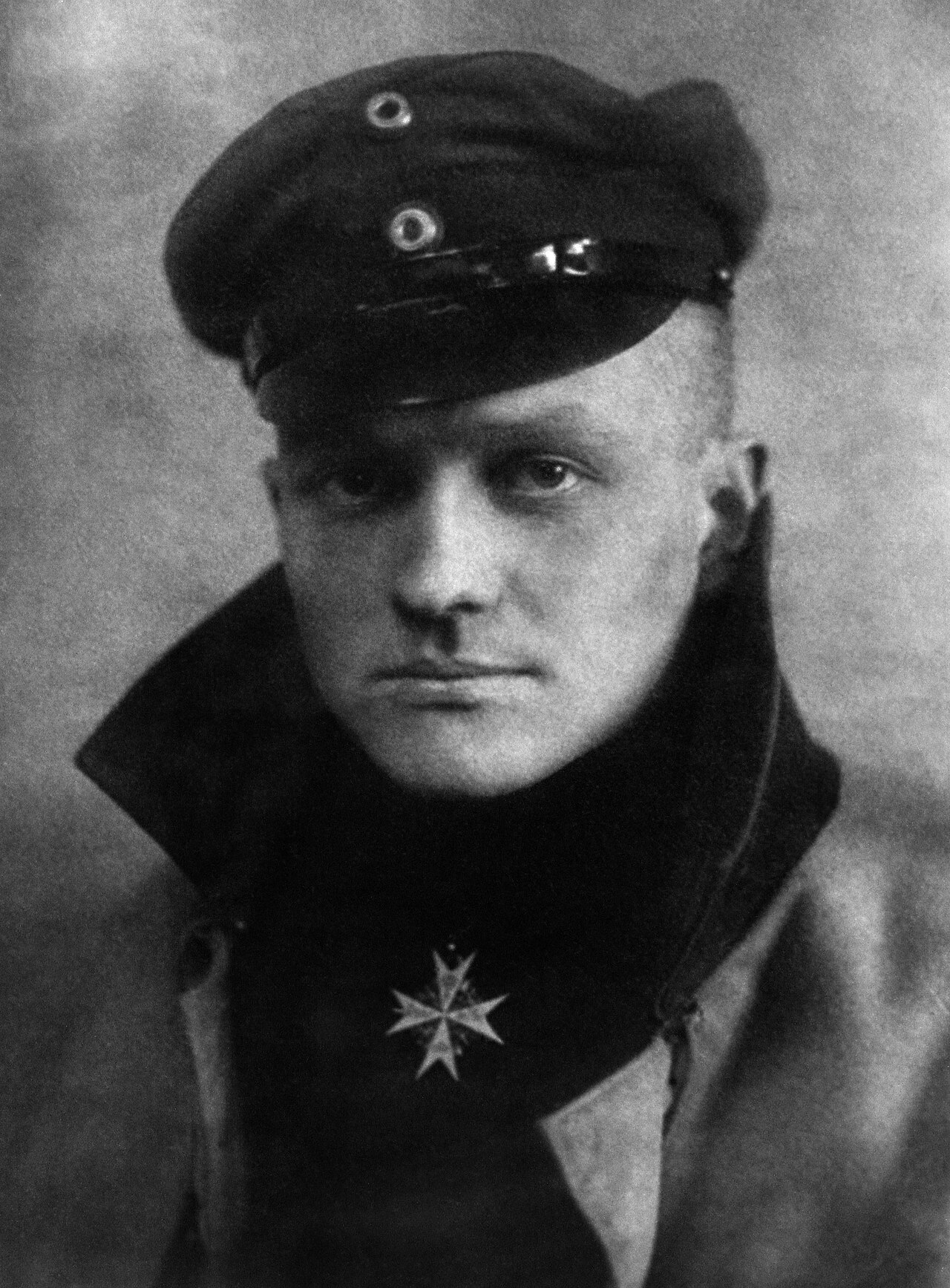
Manfred von Richthofen
A fact-based account of the life, career, and death of the highest-scoring fighter pilot of the First World War — eighty victories, commander of Jasta 11 and Jagdgeschwader 1, survivor of a head wound, killed in action at twenty-five.
Contents
- The Legend and the Record
- Family, Childhood, and Education (1892–1911)
- The Young Cavalry Officer (1911–1914)
- From Cavalry to the Air Service (1914–1916)
- Jasta 2 and the Mentorship of Oswald Boelcke (1916)
- Command of Jasta 11 and the Red Aircraft (1917)
- Jagdgeschwader 1: The Flying Circus (June 1917)
- Wounded in Combat and the Memoir (1917)
- 1918: The Triplane and the Final Victories
- Death on 21 April 1918
- Funeral, Burial, and the Body's Afterlife
- The Record: How Many Victories?
- Legacy
- Conclusion
- Bibliography & Sources
The Legend and the Record
Few soldiers of the First World War are as well known as Manfred von Richthofen, and few have accumulated as much legend. The image of a scarlet triplane and a relentlessly victorious aristocratic pilot has been shaped by propaganda, memoir, film, and popular culture. Yet Richthofen's career is unusually well documented for a pilot of his era: a full list of his credited victories exists, a large proportion of them can be matched to recorded Allied losses, and his death was investigated in writing by several medical officers on the day it occurred.
Manfred Albrecht Freiherr von Richthofen was a Prussian cavalry officer who became the highest-scoring fighter pilot of the First World War, officially credited with 80 aerial victories. A protégé of the pioneering tactician Oswald Boelcke, he commanded first Jagdstaffel (Jasta) 11 and later Jagdgeschwader 1, the mobile fighter wing popularly known as the Flying Circus.
The purpose of this document is to separate the documented record from the mythology — to present what is actually known about his family, his upbringing, his military career, his victories, his wounding, and his death, and to be explicit about where the evidence is uncertain.
Family, Childhood, and Education (1892–1911)
Manfred Albrecht Freiherr von Richthofen was born on 2 May 1892 in the village of Kleinburg, near Breslau in the Prussian province of Lower Silesia (today part of the Polish city of Wrocław). The family belonged to the Prussian landed aristocracy. His father, Albrecht Philipp Karl Julius Freiherr von Richthofen, was a major in the Prussian Army, and his mother was Kunigunde von Schickfuss und Neudorff. He was the second child — with an elder sister, Ilse — and the first of three sons; his younger brothers were Lothar, who would himself become a fighter ace with forty credited victories, and Bolko.
When Manfred was about four years old the family moved to Schweidnitz (now Świdnica, Poland). Richthofen's own memoir emphasizes a childhood of hunting and riding: the brothers hunted wild boar, elk, birds, and deer, and he was a keen gymnast who excelled at the parallel bars. After being educated at home and spending a year at a school in Schweidnitz, he began cadet training at the military school at Wahlstatt in 1903, when he was eleven. He completed the course in 1909 and transferred to the Prussian main cadet academy at Groß-Lichterfelde near Berlin, where he studied for a further two years.
The Young Cavalry Officer (1911–1914)
On 27 April 1911 Richthofen joined an Uhlan (lancer) cavalry regiment, the Ulanen-Regiment Kaiser Alexander III. von Russland (1. Westpreußisches) Nr. 1, as an officer candidate, first based at Militsch. He was commissioned a Leutnant (second lieutenant) on 19 November 1912 and was assigned to the regiment's 3rd Squadron at Ostrowo.
His cavalry background explains both the rank he later held as a pilot — Rittmeister, the cavalry rank equivalent to captain — and the hunting mentality he brought to air combat.
From Cavalry to the Air Service (1914–1916)
At the outbreak of war in August 1914, Richthofen was a cavalry reconnaissance officer. He saw action in Russia, Belgium, and France, and was awarded the Iron Cross, Second Class, on 23 September 1914. The coming of trench warfare quickly made traditional mounted cavalry operations impractical. His regiment was dismounted and its men were used as dispatch runners and field telephone operators. The final straw, as he later told it, was an order transferring him to the army's supply branch. His interest in flying had been aroused when he examined a German military aircraft behind the lines, and he applied to transfer to the Fliegertruppen (the Imperial German Army Air Service).
The "Cheese and Eggs" Quote
He was widely reported to have written in his transfer application: "I have not gone to war in order to collect cheese and eggs, but for another purpose." Notably, Richthofen's own memoir attributes this famous line to "evil tongues" rather than claiming it himself — a telling detail about how carefully he managed his own image.
His transfer was granted, and at the end of May 1915 he began training as an aerial observer. From June to August 1915 he served as an observer on reconnaissance missions over the Eastern Front. In September 1915, serving on the Champagne Front, he is believed to have shot down an attacking French Farman aircraft using his observer's machine gun — a kill never officially credited, because the enemy aircraft fell behind Allied lines and could not be confirmed.
Richthofen described his first flight as an observer with a mixture of enthusiasm and disorientation:
"I had been told the name of the place to which we were to fly, and I was to direct the pilot. At first, we flew straight ahead, then the pilot turned to the right, then left. I had lost all sense of direction over our own aerodrome!... I didn't care a bit where I was, and when the pilot thought it was time to go down, I was disappointed."
Richthofen met the German ace Oswald Boelcke by chance in 1915, and the meeting persuaded him to train as a pilot. He began flying training in October 1915 and passed his final examinations on Christmas Day 1915. His early flying was unremarkable — he crashed during his first flight at the controls, and one biographer's description of him as initially a "below-average pilot" is consistent with his own accounts. In March 1916 he joined a squadron at Verdun, flying the two-seater Albatros C.III. On 26 April 1916 he fired on a French Nieuport and shot it down over Fort Douaumont, but again received no official credit.
Jasta 2 and the Mentorship of Oswald Boelcke (1916)
Richthofen met Boelcke a second time in August 1916. Boelcke — by then Germany's leading fighter ace and a legendary instructor — was recruiting pilots for his newly formed fighter squadron, Jagdstaffel 2 (Jasta 2), and he selected Richthofen. Boelcke's eight rules of air combat, the Dicta Boelcke, became the framework of Richthofen's own tactical thinking, and he later enforced them rigorously in the squadrons he commanded.
First confirmed victory — 17 September 1916. Over Cambrai, France, at about 11:00 a.m., flying an Albatros D.II, Richthofen shot down a Royal Aircraft Factory F.E.2B of No. 11 Squadron, Royal Flying Corps. The observer, Captain Tom Rees, continued firing even as his machine was disabled, until he was killed. Richthofen landed beside the wreck.
The Silver Cups
After his first victory, Richthofen ordered a jeweller in Berlin to make him a small silver cup for each victory, engraved with the date and the type of aircraft. He continued the practice until he had sixty cups — by which stage the supply of silver in blockaded Germany had dwindled, and he discontinued the custom rather than accept cups made of base metal.
Richthofen's most celebrated early victory came on 23 November 1916, over the British ace Major Lanoe Hawker VC, whom Richthofen called "the British Boelcke." Flying his Albatros D.II against Hawker's older Airco DH.2, Richthofen fought a long, turning dogfight over the Somme. Hawker was killed by a shot to the back of the head as he tried to break off and return to his own lines. The fight convinced Richthofen that he needed a more agile aircraft even at the cost of speed, and he subsequently switched to the Albatros D.III.
Boelcke himself had been killed on 28 October 1916, before the Hawker duel, when his aircraft collided with that of another Jasta 2 pilot, Erwin Böhme, during an engagement. Richthofen witnessed the crash.
Command of Jasta 11 and the Red Aircraft (1917)
After his sixteenth confirmed victory, Richthofen was awarded the Pour le Mérite — Prussia's highest military order, informally known as the "Blue Max" — on 12 January 1917. In the same month he was appointed commander of Jasta 11. He scored Jasta 11's first victory on 23 January 1917. At this point he still held the relatively junior rank of Leutnant; he was promoted to Oberleutnant on 22 March 1917 and to Rittmeister (captain) on 7 April 1917. Under his command Jasta 11 became the highest-scoring German fighter squadron of the war, eventually claiming 350 victories.
After taking command, Richthofen had his aircraft painted bright red. His Albatros D.III, serial 789/16, was the first of his machines to be painted all red, in late January 1917. He explained his reasoning in the memoir:
"For whatever reasons, one fine day I came upon the idea of having my crate painted glaring red. The result was that absolutely everyone could not help but notice my red bird. In fact, my opponents also seemed to be not entirely unaware [of it]."
He gave his mother a different justification during an unexpected visit home on 4 February 1917. When she called the paint scheme frivolous, he told her the main point was that his own men could always see him, and that he risked his life every day "for the man in the trenches," to ease the soldiers' hard lot by keeping enemy aircraft away from them.
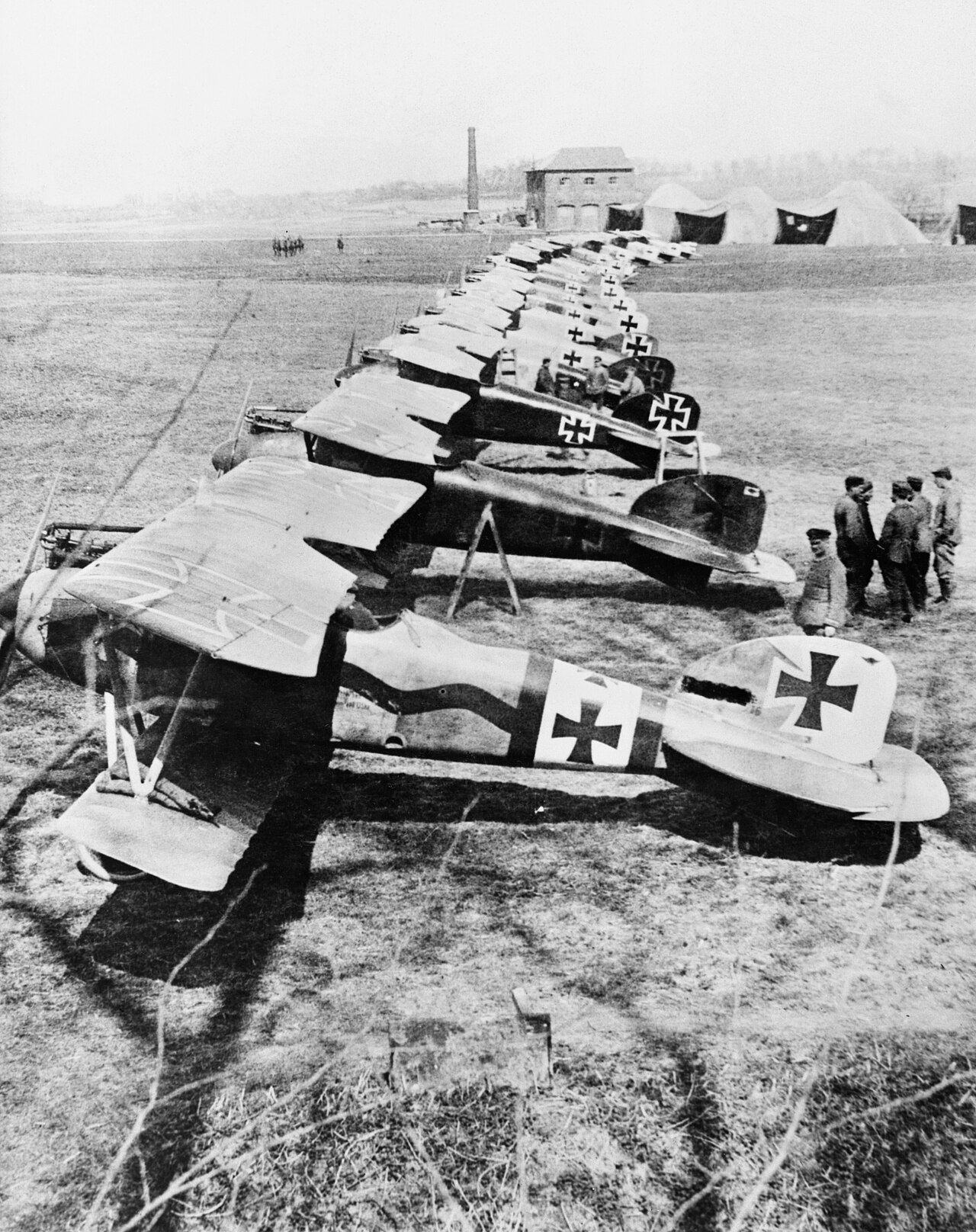
The name "Red Baron" derived from two facts: his noble title of Freiherr (often translated as "baron") and the colour of his aircraft. During his lifetime he was more commonly called in German der rote Kampfflieger — "the Red Fighter Pilot" — and this became the title of his 1917 memoir. The English-language nickname "Red Baron" is the one that survived into general use. Other members of Jasta 11 soon painted parts of their aircraft red, officially to keep their leader from being singled out but in practice as a unit identification.
"Bloody April" (1917)
In April 1917, during the Battle of Arras, the Royal Flying Corps suffered its worst month of the war — a period the RFC itself came to call "Bloody April." Sources place RFC aircraft losses at roughly 245–275 aircraft, with more than 200 aircrew killed; German records show about 66 German aircraft lost in the same period. Jasta 11 alone was credited with 89 victories that month, more than a third of the British losses.
One of the month's most dramatic engagements came on 5 April, when six brand-new Bristol F.2A fighters of No. 48 Squadron, led by Captain William Leefe Robinson VC (the pilot who had shot down a German airship over Britain in 1916), met Richthofen leading five Albatros D.IIIs. Two of the Bristols were shot down by Richthofen himself and two more by his squadron; Robinson was shot down and captured, and only two of the six British aircraft returned.
Richthofen's personal tally for the month was 21 confirmed victories, and his overall score reached 52 by the end of April. On 29 April 1917 he achieved his fiftieth confirmed victory, and the German Emperor, Kaiser Wilhelm II, sent him a congratulatory radiogram. His most successful single day of the war in terms of confirmed kills was 13 April 1917, when he shot down three British aircraft in one patrol.
Jagdgeschwader 1: "The Flying Circus" (June 1917)
In June 1917 the German air service created its first permanent large fighter formations. Richthofen was given command of Jagdgeschwader 1 (JG 1), composed of four fighter squadrons — Jastas 4, 6, 10, and 11 — with an effective strength of roughly forty-eight aircraft. The wing became known to its opponents as Richthofen's Flying Circus because of the brightly coloured aircraft and because it was highly mobile, moving by rail and tent to whatever part of the front needed it.
Richthofen ran the wing as Boelcke had run Jasta 2. He enforced disciplined formation flying, forbade reckless showmanship, and taught his pilots a simple combat rule he later described as:
"Aim for the man and don't miss him. If you are fighting a two-seater, get the observer first; until you have silenced the gun, don't bother about the pilot."
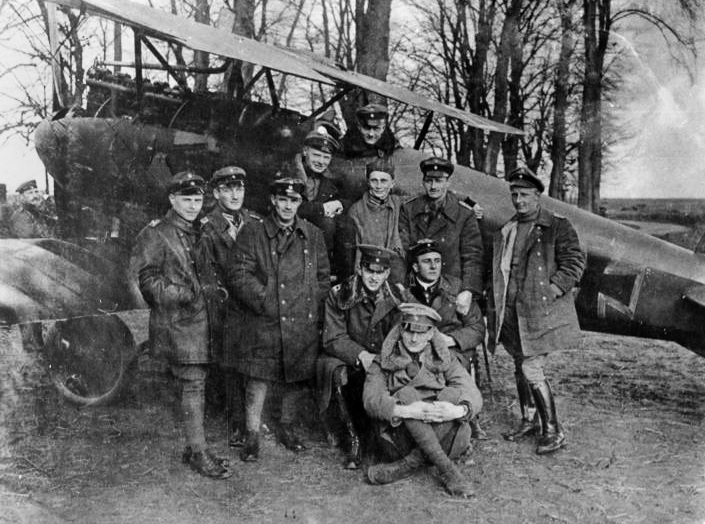
He was regarded as a fine tactician and a fine marksman rather than a spectacular aerobat; his standard method was to attack from above with the sun behind him, while his formation covered his rear and flanks.
Despite the scale of his command — the duties of a wing commander — Richthofen was never promoted beyond Rittmeister. German officers were promoted by schedule rather than by battlefield appointment, and there was a convention that a son should not outrank his father, who was a reserve major.
Wounded in Combat and the Memoir (1917)
On 6 July 1917, during combat near Wervik in Belgium against a formation of F.E.2d two-seat fighters of No. 20 Squadron RFC, Richthofen was struck in the head by a bullet behind his left ear. He was temporarily blinded and disoriented but regained his vision in time to pull the aircraft out of a spin and force-land in friendly territory. The wound required multiple operations to remove bone splinters. He returned to active service against doctors' orders on 25 July 1917, and then took convalescent leave from 5 September to 23 October. The wound is thought to have caused lasting problems: he later suffered post-flight nausea and headaches and a change in temperament.
During his convalescence he wrote an autobiographical sketch, Der rote Kampfflieger (The Red Battle Flyer), published by the Ullstein house in Berlin in 1917. The book was written at the instruction of the propaganda section of the air service and was heavily censored and edited. It nevertheless contains passages that an official editor is unlikely to have written, most famously his reflection on hunting:
"My father discriminates between a sportsman and a butcher. The latter shoots for fun. When I have shot down an Englishman, my hunting passion is satisfied for a quarter of an hour.... Only much later have I overcome my instinct and have become a butcher."
A Private Confession
Richthofen later repudiated the tone of the book. A private, posthumously published passage recorded him saying, "I now have the deepest impression that from [the image of] the 'red battle flier', people have been exposed to quite another Richthofen than I am truly deep inside of myself.... I am no longer so insolent." In the same text, sometimes titled "Thoughts in a Dug-Out," he described a lamp he had made from a rotary aircraft engine salvaged from a machine he had shot down — and confessed: "I am in wretched spirits after every aerial combat. But that is surely one of the consequences of my head wound."
By 1918 Richthofen had become so important as a national symbol that some German commanders feared his death would damage civilian morale. He refused offers of a ground job, saying that "every poor fellow in the trenches must do his duty" and that he would therefore keep flying.
1918: The Triplane and the Final Victories
Richthofen is permanently associated with the Fokker Dr.I triplane, and it was in a red Dr.I that he died. The association, however, is stronger than the record: he flew the triplane only from late August 1917, and only 19 of his 80 victories were scored in triplanes (including two in the pre-production Fokker F.I). The large majority of his kills were made in Albatros fighters.
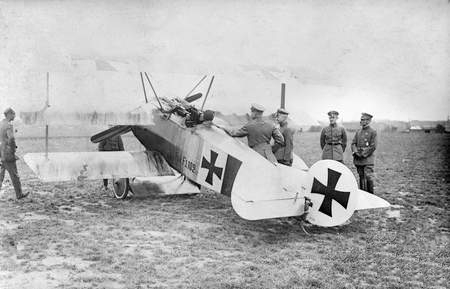
In late October 1917 the triplane was grounded after a series of fatal wing failures: Heinrich Gontermann was killed on 29 October when his Dr.I broke up in flight, and Günther Pastor of Jasta 11 was killed two days later when his machine broke apart in level flight. Richthofen himself crash-landed a triplane on 30 October 1917. All remaining triplanes were grounded on 2 November 1917 pending an inquiry, which found that poor construction and moisture damage in the wing structure were to blame; the type was strengthened and returned to service at the end of November 1917.
During the German Spring Offensive of March–April 1918, JG 1 operated in support of the ground advance in the Somme region. Richthofen scored his seventieth victory in early April 1918 and was awarded the Order of the Red Eagle, 3rd Class with Crown and Swords, on 2 April 1918.
On the afternoon of 20 April 1918 he scored his 79th and 80th — and final — confirmed victories in a single engagement, shooting down two Sopwith Camels of No. 3 Squadron RAF: Major Richard Raymond-Barker, who was killed, and Second Lieutenant David Greswolde Lewis, who survived, wounded and taken prisoner. These were the last victories of his life. The following morning he was dead.
Death on 21 April 1918
On Sunday, 21 April 1918, JG 1 met a formation of Sopwith Camels over the Somme region. Richthofen was flying his red Fokker Dr.I, serial 425/17. Just after 11:00 a.m., at very low altitude, he began pursuing a Sopwith Camel flown by Wilfrid Reid "Wop" May, a young and relatively inexperienced Canadian pilot of No. 209 Squadron RAF. May had just fired on Richthofen's cousin, Lieutenant Wolfram von Richthofen; Richthofen flew to his cousin's rescue, fired on May, and then pursued him across the Somme valley.
Richthofen's pursuit was interrupted by May's flight commander and school friend, Captain Arthur "Roy" Brown, who dived steeply to intervene, fired at the red triplane, and then had to climb hard to avoid the ground. Richthofen turned to avoid Brown's attack and then resumed his chase of May. It was almost certainly during this final stage, as he flew low over ground held by the Australian Imperial Force, that he was hit.
A single .303-inch bullet entered his chest from the right side, passing through his heart and lungs. It would have killed him within about a minute. His aircraft stalled, dived, and crashed in a field near the village of Vaux-sur-Somme, in a sector defended by Australian troops. The machine bounced heavily on impact; the undercarriage collapsed and the fuel tank was smashed. Richthofen's face struck the breech handles of his machine guns, breaking his nose and fracturing his jaw.
The Medical Evidence
The body was taken to the hangar of No. 3 Squadron, Australian Flying Corps, at Poulainville, where it was examined on 21–22 April 1918 by a panel of medical officers. Two written reports survive in the Australian War Memorial's Bean Papers.
- Colonel T. Sinclair reported an entrance wound on the right side at the level of the ninth rib, with the bullet passing obliquely through the chest, striking the spinal column, and exiting on the left side about two inches higher. His examination was later judged superficial — the doctors traced the wound channel with a piece of fence wire rather than a proper surgical probe.
- Captains G. C. Graham and Lieutenant G. E. Downs reported an entrance wound in the right armpit and an exit wound near the left nipple, concluding the bullet had passed straight through the chest from right to left.
- In 1935, Colonel George W. Barber, who examined the body on the same day, wrote that the bullet had "passed through the chest and the heart," that the bullet hole in the side of the aircraft coincided with the wound, and that "he was shot from below while banking."
On the basis of these records, the physician and military historian Dr. M. Geoffrey Miller concluded in 1998 that the bullet entered the right side of the body, from behind and below, and passed through the heart. A wound of that severity would have caused loss of consciousness within 20–30 seconds.
Who Fired the Fatal Shot?
The Royal Air Force officially credited Captain Roy Brown with shooting down the Red Baron, and Brown received a bar to his Distinguished Service Cross for it. But this attribution has been doubted almost from the day of the death. The Australians, whose soldiers and gunners had been shooting at the low-flying triplane, disputed the RAF's credit from the start, and the postwar analysis has overwhelmingly favoured ground fire.
Three main candidates have been put forward, all Australian:
- Sergeant Cedric Popkin of the Australian 24th Machine Gun Company, firing a Vickers machine gun. Popkin's position was south of the triplane's flight path, and he fired at Richthofen twice — first as the aircraft flew straight toward him, and then, more importantly, as it banked away. The angle of his second burst is consistent with the wound, which entered from the right, behind and below. C. E. W. Bean, author of the Official History of Australia in the War of 1914–1918, concluded after detailed research in the 1930s that Popkin was responsible. Miller's analysis, based on the original autopsy records, endorsed Popkin as "more probable than not."
- Gunner W. J. "Snowy" Evans of the 53rd Battery, firing a Lewis gun on an anti-aircraft mounting. Miller and a 2002 Channel 4 documentary dismissed Evans because of the angle from which he fired.
- Gunner Robert Buie, also of the 53rd Battery, firing a Lewis gun. Buie's account describes firing at the triplane from the front as it came toward him. A frontal shot cannot produce a wound that entered from the side and behind, so Miller judged Buie's claim impossible on the medical evidence.
Why It Could Be Anyone
Miller's conclusion was deliberately hedged: Popkin was the most likely candidate, but a lucky shot from any unidentified Australian soldier firing a standard .303 rifle cannot be excluded — because the fatal bullet was an ordinary .303 ball round common to every British rifle and machine gun of the period, and the original bullet was not preserved for modern examination.
What is certain is that the wound could not have been inflicted by Brown at the moment required by the RAF account: Richthofen continued to pursue May for up to two minutes after Brown's attack, which is impossible if his heart had already been destroyed.
Theories About the Final Flight
Richthofen's final flight was uncharacteristic. He was an experienced pilot who knew the danger of ground fire, and he had followed Boelcke's rule against unnecessary risk. Yet he pursued a single novice pilot low over enemy lines for an extended distance. Several explanations have been advanced, all speculative but documented:
- The lingering effects of the July 1917 head wound. In 1999 the German medical researcher Henning Allmers published an article in The Lancet suggesting that brain damage from the 1917 wound may have impaired Richthofen's judgment on the final flight; a 2004 study by researchers at the University of Texas supported the idea.
- Cumulative combat stress. Richthofen had been flying continuously for two and a half years; other leading aces of the war (Mick Mannock and Georges Guynemer) also died after errors against which they had warned others.
- An unusual wind. On the day of his death the wind was easterly, blowing westward across the lines, so that Richthofen's ground speed was unusually high and he could easily have crossed into enemy territory without realising how far he had gone.
Funeral, Burial, and the Body's Afterlife
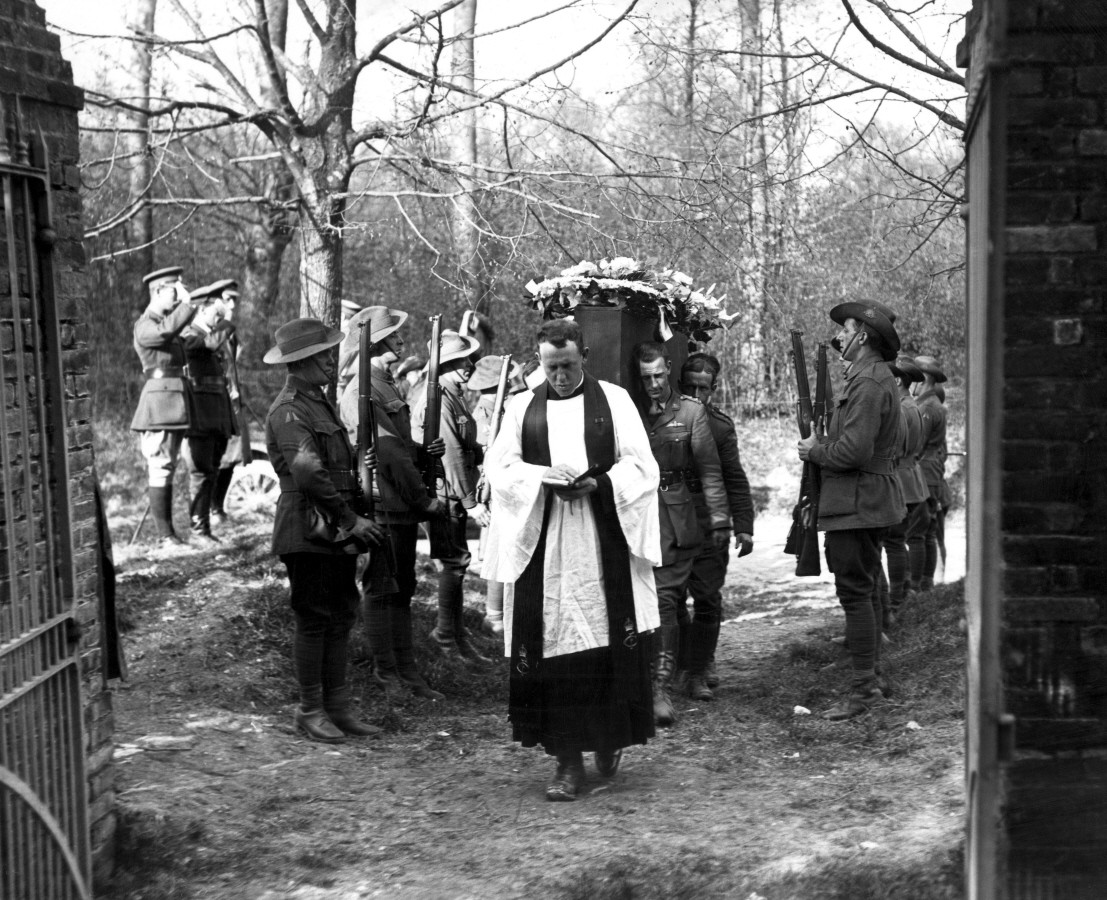
No. 3 Squadron AFC, the nearest Entente air unit, took responsibility for Richthofen's remains. Its commanding officer, Major David Blake, ordered a full military funeral, an act of respect consistent with the general regard in which Allied airmen held their most famous opponent.
Richthofen was buried on 22 April 1918 in the cemetery at Bertangles, near Amiens. Six of No. 3 Squadron's officers served as pallbearers and a guard of honour from the squadron fired a salute. Allied squadrons stationed nearby sent wreaths; one was inscribed "To Our Gallant and Worthy Foe."
An Unusual Gravestone Story
In the early 1920s the French authorities reinterred his remains in the German military cemetery at Fricourt. In 1925 Richthofen's youngest brother, Bolko, recovered the body and brought it to Germany. The family had intended burial at Schweidnitz, beside the graves of his father (died 1920) and his brother Lothar (killed in a postwar air crash in 1922), but the German government requested instead that the body be interred in the Invalidenfriedhof cemetery in Berlin. During the Cold War the grave lay on the boundary of the Soviet sector of Berlin, and the tombstone was damaged by bullets fired at people attempting to escape across the Wall. In 1975 the body was moved to the Richthofen family grave at the Südfriedhof (South Cemetery) in Wiesbaden, where it remains.
The Record: How Many Victories?
Richthofen was officially credited with 80 victories. His score is among the best documented of any First World War pilot. A full list of his credited victories was published as early as 1958, and of the 80 credited claims, 73 can be matched to recorded British losses with squadron details, aircraft serial numbers, and the names of the Allied airmen involved. The study by historian Norman Franks and two colleagues, Under the Guns of the Red Baron (1995), reached the same conclusion about the accuracy of the record.
For comparison, the highest-scoring Entente ace was the Frenchman René Fonck with 75 confirmed victories; among British Empire pilots, Billy Bishop was credited with 72, Mick Mannock with 61, and James McCudden with 57.
Legacy
During the war, Richthofen was the centrepiece of a deliberate cult of hero-worship. His memoir was an instant success — the second-best-selling German war book of the conflict — and postcards of him were collected on both sides. For a German public facing a stalled Western Front and mounting losses, his steadily climbing tally of victories provided "some sense of knowable victory."
After the war the legend was adapted by successive regimes. Hermann Göring, himself a wartime JG 1 pilot and later Richthofen's successor as commander of the wing, wrote an introduction to a Third Reich reissue of the memoir, and the Luftwaffe named fighter units in his honour — including Jagdgeschwader 132 "Richthofen" (1936), Jagdgeschwader 2 "Richthofen" (1939–1945), and, after 1959, the first jet-fighter wing of the postwar German air force, Jagdgeschwader 71 "Richthofen," founded by the highest-scoring ace of all time, Erich Hartmann.
Physical relics survive in museums: the engine of his Dr.I is in the Imperial War Museum in London; the seat of his final aircraft and a side panel signed by the pilots of Roy Brown's squadron are at the Royal Canadian Military Institute in Toronto; and his control column and flying boots are at the Australian War Memorial in Canberra. In 1968 he was inducted into the International Air & Space Hall of Fame.
A recurring historical question is whether the legend exaggerated his skill. The documentary record argues against major exaggeration: his victories check out against Allied loss lists to a high degree, and he continued to score heavily — including his last two victories on 20 April 1918 — against a numerically superior enemy flying, on the whole, better aircraft than his own. It is also true that his red aircraft was not always entirely red, that he scored fewer than a quarter of his victories in the famous triplane, and that his greatest value to the German air service may have been as a leader and tactician rather than simply as a marksman.
Conclusion
Manfred von Richthofen's career can be traced with unusual precision for a man who lived only twenty-five years and died in 1918: from a Prussian aristocratic childhood of riding and hunting, through cavalry service in 1914, to observation flying in 1915, to the fighter squadrons where Boelcke trained him and where he became the most successful combat pilot of the war.
His documented record — 80 credited victories, the command of Jasta 11 and then of the first fighter wing, the survival of a serious head wound in July 1917, and his death on 21 April 1918 while pursuing a novice pilot over the Somme — stands on firmer evidence than almost any other ace's. The one genuinely unresolved question, the identity of the man who fired the bullet that killed him, is a matter of surviving records rather than of lost ones: the medical reports and eyewitness statements point most strongly to the Australian Vickers gunner Sergeant Cedric Popkin, while explicitly leaving open the possibility of an unknown rifleman.
What the record does not support is the portrait of an invincible, all-red legend. Richthofen was a real and remarkably effective combat pilot, promoted by propaganda into a symbol — and it is the real record, not the symbol, that makes his story worth studying.
Bibliography & Sources
All claims above are drawn from the primary and secondary sources cited below. Figures that vary between reputable sources are stated with the range noted. Urban myths, folklore, and unverified legends have been excluded.